Published: 23 February 2026
Minister’s Award for School of Form team: Bringing the Faras costumes to life
Author: Magdalena Miszewska
A team of designers from School of Form at SWPS University and researchers from the University of Warsaw received the Minister of Science and Higher Education Award for implementation. This prestigious honor recognizes an innovative project that brought medieval paintings to life through intricately recreated garments.
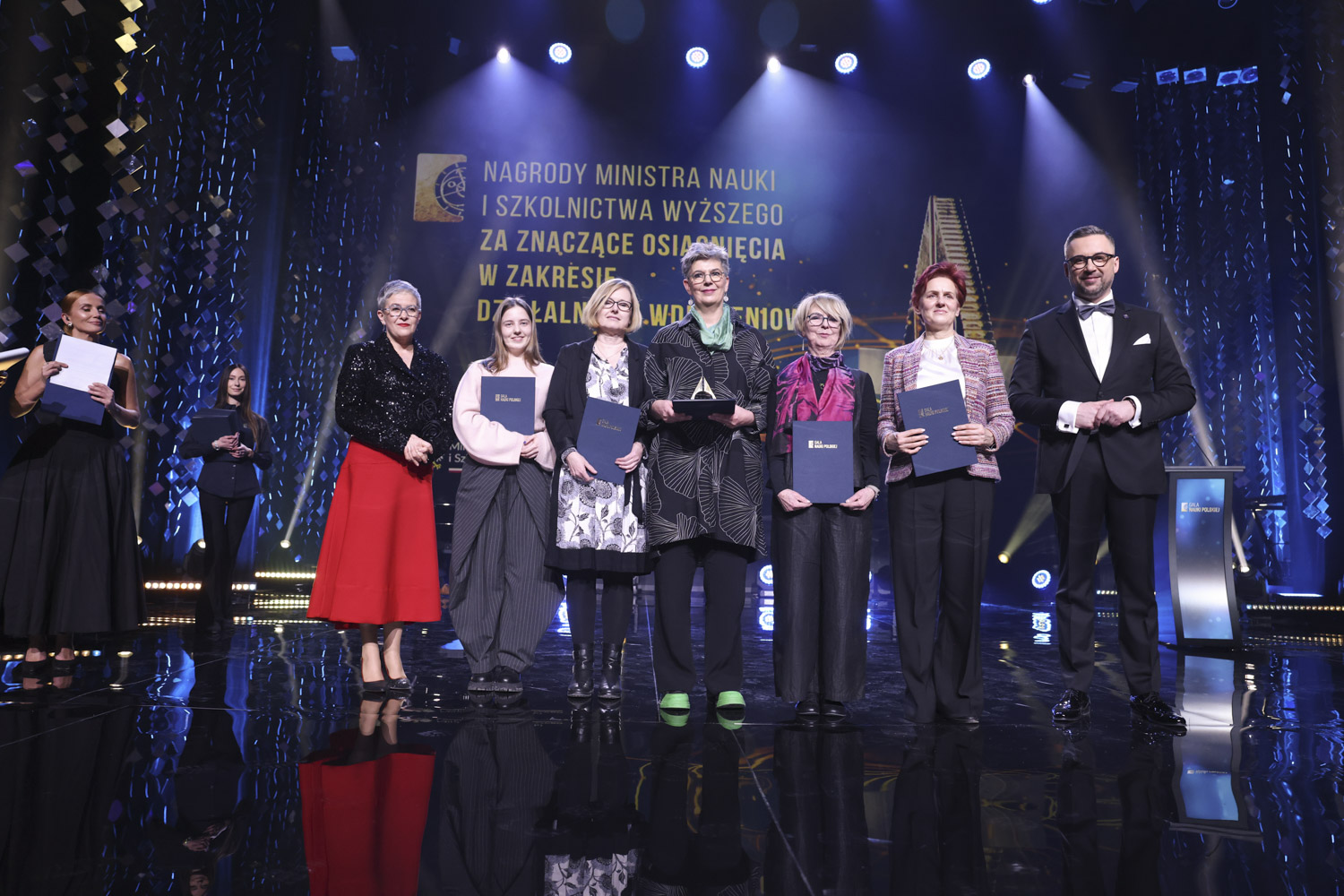
Our designers among the honorees
On February 20, the Polish Theatre in Warsaw hosted the Polish Science Gala. During the event, Minister of Science and Higher Education Marcin Kulasek presented awards to top researchers and creators whose achievements are driving Poland's development.
The team responsible for reconstructing costumes based on the Faras paintings took home an award for outstanding achievements in implementation. It is a huge recognition for their project, "Costumes of Authority. The Image of Royalty and Clergy in Christian Nubia.".


The project revolutionizes the popularization of science by using the 'archaeology of the senses'—a method that attempts to interpret material culture and past ways of life through scientific experiments. Applied to this project, the method translates complex historical research into an accessible and engaging experience.
Excerpt from the Minister’s Award justification
Time travel to medieval Nubia
"Costumes of Authority" is the result of a two-year collaboration between University of Warsaw — Dr. Karel Innemée, Dr. Magdalena Woźniak-Eusèbe, i and Prof. Dobrochna Zielińska — archaeologists and School of Form designers. It all started with the unique frescoes discovered in the Faras Cathedral back in the 1960s.
The team Led by Dr. Agnieszka Jacobson-Cielecka turned flat, two-dimensional images into fully functional 3D forms. They carefully analyzed how the robes should be constructed, how heavy they should be, and how they would affect human movement. The designers hand-dyed fabrics—linen, cotton, silk, and wool—with natural dyes originally used in Nubia, finishing them with hand-embroidered and printed details. This hands-on process allowed them to recreate five silhouettes: two kings, two royal mothers, and a bishop.
Find out more about the project
Dr. Agnieszka Jacobson-Cielecka and Dr. Karel Innemée share how they bridged the gap between archaeology and design to recreate the Nubian robes.
Project with a mission
The reconstructed garments have sparked huge interest worldwide. They have already been showcased at the Louvre in Paris, the Bode Museum in Berlin, and the SOAS Gallery at the University of London.
But the project is about much more than just history — it carries a strong social message. Models of Sudanese descent showcase the garments. Accompanied by the hashtag #keepeyesonsudan, the initiative highlights the urgent need to protect Nubian heritage amid the ongoing civil war in Sudan.
The creators behind the success
This project proves the power of an interdisciplinary approach. The Minister’s Award went to a diverse team of experts: Agnieszka Jacobson-Cielecka, Ph.D. / Assistant Professor, Dorothée Roqueplo, Katarzyna Schmidt-Przewoźna, Ph.D. / Associate Professor, Paulina Matusiak, Eddy Wenting, Karel Innemée Ph.D., Magdalena Woźniak-Eusèbe, Ph.D., Dobrochna Zielińska, Ph.D. / Associate Professor, Teresa Holc, Dorota Bąkowska, Małgorzata Olesińska, Alicja Kozłowska, Anastasiya Bernatovich, Monika Medyńska-Mańko, Elizabet Khmellier, Bartosz Głowacki, Jakub Łagunionok, and Stanisław Macleod.